Okay it is the end of the day here in Australia and I am really flagging, so I am going to keep it short and sweet. In another demonstration of the banking industry's predilection for presuming that everybody knows it is talking about, the message about including BICs (Bank Identifier Codes) and IBANs(International Bank Account Numbers) on cross-border payments does not appear to have sunk in.
According to Jonathan Williams of Eiger Systems, which provides software for managing BICs and IBANs, the banks presumed that everybody knew about BICs and IBANs when they were first mentioned as a means of reducing the cost of cross-border payments in euro as part of the European Commission's 2001 Cross-border Payments Directive.
From 1 January this year, BICs and IBANs were made mandatory for European cross-border euro credit transfers, but according to one payments vendor, there are few payments within Europe that carry the requisite details, and therefore are not processed as cheaply as a domestic payment.
The upshot of all this however is that since 2003 when the Cross-Border Payments Directive took effect, banks have been charging extra to process payments that do not contain the correct BIC and IBAN details. "There are examples of companies being penalised £20 per transaction," says Williams.
However, he gives the Royal Bank of Scotland a pat on the back for being explicit about the charges it will levy on customers that don't include BICs and IBANs. Meanwhile, in the US it seems that companies there and banks doing business with Europe, do not give a monkeys about BICs and IBANs. "There is a lot of misunderstanding in the US about IBANs," says Williams. Quite frankly neither do corporates it would seem with one French corporate stating it had yet to be convinced of the business case and cost of implementing them.
Given the pressure on banks' revenue streams from competition and regulation, it would appear that not informing their customers adequately about BICs and IBANs is one sure way of making up dwindling revenues, until the banks can think of something better, like adding value.
Showing posts with label Sibos in Sydney - payments. Show all posts
Showing posts with label Sibos in Sydney - payments. Show all posts
Thursday, October 12, 2006

Time to get serious about SEPA
The title of this post may sound like an oxymoron. After all, I have heard nothing but SEPA all this week at the Sibos conference in Sydney and I am suffering from SEPA fatigue. Is there anything left to say about SEPA?
Well it appears there is, or at least I have managed to interview somebody that has something else to say about SEPA that I thought you should all know. My judgement, however, may be clouded by now.
Anyways, as much as there is a strong whiff of SEPA in the air at Sibos, a number of observers believe that banks need a proverbial ... up their ... "The banks have got to get more serious about SEPA, otherwise the regulators are going to step in," says Karen Cone of TowerGroup.
A number of the larger global cash management banks (along with the vendors that all have SEPA solutions proudly on display promising a hassle free migration to SEPA - it is a bit like taking a headache tablet that makes the pain go away); appear to be rubbing their hands together with glee at the prospect of SEPA as the prediction is that it will be all about who has the greatest volume.
A number of these banks are also fairly well advanced in terms of consolidating their multitude of payment systems onto a single platform, which people like Joe Mazzetti of Fundtech believes is key to managing SEPA. "Our mantra is the convergence of payment systems to do one thing," says Mazzetti. The thinking is that low value and high value payments will merge so banks will only need a single platform for all payments.
Some believe, however, there is too much focus on the complexity and 'pain' of SEPA - just one of the hundreds of regulations that banks have to comply with - and not the opportunities it presents. "There should be more of a focus on how banks can take advantage of SEPA to differentiate their services," says Mazzetti.
Easier said than done though when SEPA to most banks constitutes further commoditisation of payments, declining revenues and a strategic re-engineering of their payments business.
Despite the many 'pain points' around SEPA, Ralph Silva, research director, TowerGroup, believes that banks have a "social responsibility" to make SEPA work.
TowerGroup CEO Karen Cone believes it is more about a fundamental cultural shift that needs to occur within banks. Although analyst outfits like TowerGroup hardly paint a rosy picture for the future of the payments business - by 2016 it predicts that 80% of the world's payments processing will be concentrated in the hands of 25 banks - it is not just about the big banks hoovering up the small fry.
Cone says it is much more about banks really coming to grips with the concept of white labelling to the extent that outsourcing their payments business to their competitor or another bank is a 'no brainer'. Banks can still compete but on the front-end customer channel, not the back end. It has been said before, but banks don't seem to have got their heads around this. It is time for some of them to eat humble pie.
Well it appears there is, or at least I have managed to interview somebody that has something else to say about SEPA that I thought you should all know. My judgement, however, may be clouded by now.
Anyways, as much as there is a strong whiff of SEPA in the air at Sibos, a number of observers believe that banks need a proverbial ... up their ... "The banks have got to get more serious about SEPA, otherwise the regulators are going to step in," says Karen Cone of TowerGroup.
A number of the larger global cash management banks (along with the vendors that all have SEPA solutions proudly on display promising a hassle free migration to SEPA - it is a bit like taking a headache tablet that makes the pain go away); appear to be rubbing their hands together with glee at the prospect of SEPA as the prediction is that it will be all about who has the greatest volume.
A number of these banks are also fairly well advanced in terms of consolidating their multitude of payment systems onto a single platform, which people like Joe Mazzetti of Fundtech believes is key to managing SEPA. "Our mantra is the convergence of payment systems to do one thing," says Mazzetti. The thinking is that low value and high value payments will merge so banks will only need a single platform for all payments.
Some believe, however, there is too much focus on the complexity and 'pain' of SEPA - just one of the hundreds of regulations that banks have to comply with - and not the opportunities it presents. "There should be more of a focus on how banks can take advantage of SEPA to differentiate their services," says Mazzetti.
Easier said than done though when SEPA to most banks constitutes further commoditisation of payments, declining revenues and a strategic re-engineering of their payments business.
Despite the many 'pain points' around SEPA, Ralph Silva, research director, TowerGroup, believes that banks have a "social responsibility" to make SEPA work.
TowerGroup CEO Karen Cone believes it is more about a fundamental cultural shift that needs to occur within banks. Although analyst outfits like TowerGroup hardly paint a rosy picture for the future of the payments business - by 2016 it predicts that 80% of the world's payments processing will be concentrated in the hands of 25 banks - it is not just about the big banks hoovering up the small fry.
Cone says it is much more about banks really coming to grips with the concept of white labelling to the extent that outsourcing their payments business to their competitor or another bank is a 'no brainer'. Banks can still compete but on the front-end customer channel, not the back end. It has been said before, but banks don't seem to have got their heads around this. It is time for some of them to eat humble pie.
Tuesday, October 10, 2006
I hate to break it to you guys, but SEPA is not a huge priority for corporates
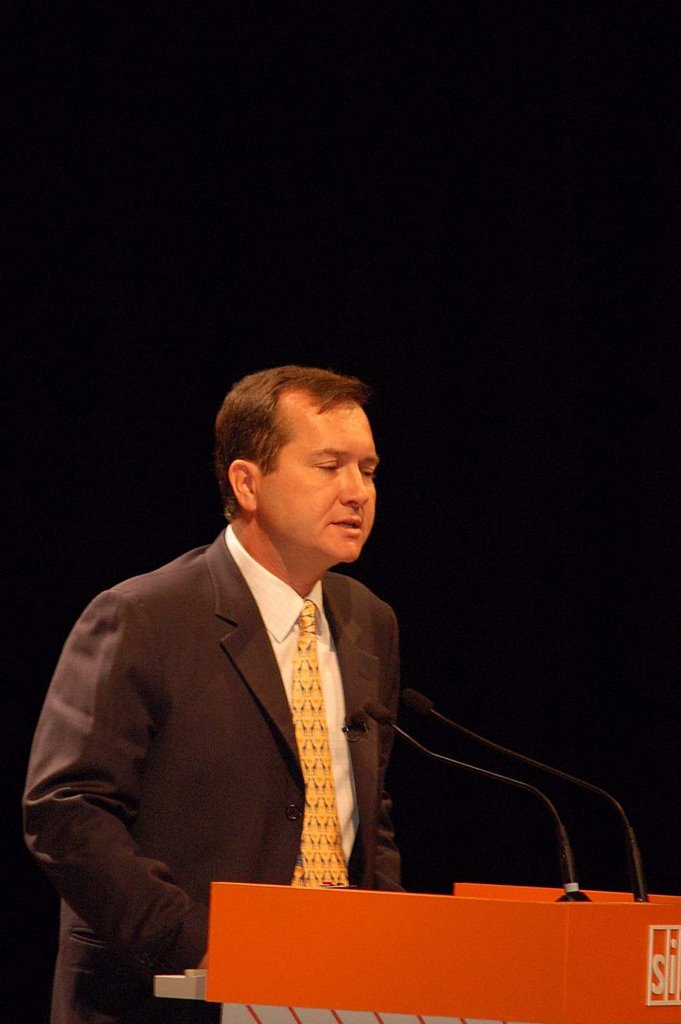
Ok here's how it goes. The banks, the European Commission and the European Central Bank have been banging on about this thing called SEPA (the Single Euro Payments Area. I think I am suffering from SEPA fatigue.
Anyway, at the second day of the Sibos conference, Natexis Banque Populaire and Unicredit outlined how they were preparing for SEPA in terms of developing a single operating platform, the need for testing and for banks to decide whether they want to be on the manufacturing side of the business or outsource their payments business to someone else.
Then Vincent Herlicq from the French corporate treasury association AFTE took to the stage and proceeded to tell the banks, well actually we may support the concept of SEPA, but it is not a major priority for most corporates. Oh and by the way, we are not going to be ready by 2008, the start of the transition period to SEPA. In fact, it could take corporates six years to migrate to SEPA which means instead of the 2008-2010 transition period most banks had planned on, they may have to run legacy and SEPA instruments in parallel for a few years longer.
"There is no widespread coverage of SEPA within the general population," said Herlicq. "SEPA is still not a real concern. I don't know any corporate that will have a high volume of SEPA instruments in 2008. We are not ready for that."
While the banks may still be deciding how SEPA impacts their business, the corporates it seems have not even got that far. The challenge for treasurers says Herlicq is to convince the CFO to invest in the SEPA project at all and until they can do that the move to BIC (Bank Identifier Code) and IBANs (International Bank Account Numbers) is not going to carry the same sense of urgency as the banks would like, at least not for those corporates whose business is still largely domestic.
It seems the banks, in particular the European Payments Council (EPC) have done a great job at educating corporates as to why they should move to SEPA or the new payment instruments that the EPC developed rulebooks for. "The EPC rule books are too complex," said Herlicq. "We would like a more simplified version," which was met with a rather bemused grin by Gerard Hartsink, the chairman of the EPC, who earlier had reeled off an excerpt from a press release by the European Association of Corporate Treasurers as if to say, SEPA, as the banks have defined it, has corporates' blessing.
According to Herlicq, corporates also need to be convinced that the SEPA instruments are a significant improvement on the domestic payment instruments companies are currently using. Talk about project mismanagement.
Corporates could possibly be incentivised to take SEPA more seriously if the banks were more forthcoming on pricing, but the banks are being cagey on that front. Bernard Gouraud of Natexis Banque Populaire gave some explanation as to why. "How can we talk about price when banks will have to run legacy systems in parallel with SEPA instruments."
Monday, October 09, 2006
Big banks will not have it all their own way

With a rather expensive yacht moored in Darling Harbour, Logica CMG is certainly making its presence felt at the Sibos 2006 conference in Sydney Australia.
Before boarding the boat I was asked to remove my shoes and found myself in a rather unique situation; interviewing Jerry Norton, the director, strategy, global financial services, Logica CMG, in my bare feet whilst he sat there with his socks on. It was one of those situations where you think to yourself I am glad I painted my toenails, or in Mr Norton's case wore socks without holes in them.
Naked feet aside, the luxurious yacht certainly signifies Logica CMG's new found confidence fresh from its announcement of its acquisition of WM-data, which will enable it to expand its geographical footprint in the Nordic and Baltic markets. Once the deal is finalised, the combined companies will have a turnover of £3.1 billion, and according to Norton it will also make Logica one of the Top 20 companies of its type globally.
With regulators calling for greater harmonisation and convergence of payments in Europe, Norton believes Logica is well placed to provide end-to-end capabilities for all payments (interbank, retail and corporate). Of course the question on everyone's lips is what impact will the Single Euro Payment Area (SEPA) have on their payments business?
Norton like most believes that the payments business (much like its equivalent in the securities world, custody) will consolidate into the hands of fewer providers. The need to run SEPA and non-SEPA payments infrastructure in parallel during the SEPA transition period from 2008 to 2010, is likely to be "the straw that breaks the camel's back," says Norton in terms of smaller banks deciding whether they want to remain in the payments business or outsource it to a scale provider.
Nothing new there, however, Norton believes that the global cash management banks will not have it all their own way. "In terms of how banks speak to their customers, the banks that recognise and respect local customisation, that is where the opportunity is for the regional players." In this respect, Norton believes that cultural issues gives European banks a competitive advantage over US banks who see SEPA as an opportunity to make their "stamp" on Europe.
But before SEPA comes to fruition, there are a number of things banks need to consider, not least of which, says Norton is the 'testing issue'. "There needs to be end-to-end testing in the market to ensure that SEPA standards are not implemented differently in different countries," he says. "And the testing has got to be done now."
Banks also need to do a better job at selling SEPA to corporates, says Norton."The dialogue is starting but there is a long way to go." In terms of adoption of SEPA instruments, Norton believes that government organisations and the European Commission should lead the way. "Banks are looking for some sort of assistance," and if the EC says it is going to use pan-European credit transfers, Norton believes other customers will follow.
Under the terms of the Payment Services Directive, which provides the legal framework for SEPA, Norton is adamant that non-bank payment providers such as First Data Corp. are likely to emerge. The question is, will these non-bank providers be subject to the same regulation as banking providers?
Global remittances sorted?

At a time when European ACHs are having to justify their business strategies and compete in what is largely a volume business, Voca CEO Marion King was positively beaming as she announced the UK clearing house's partnership with Citigroup in providing a "low cost" global remittance solution for UK banks.
According to World Bank figures, the global remittance business (foreign nationals sending money back to their home countries)generates somewhere in the region of £49 billion a year. Yet, the banks have been relatively unsuccessful in capturing the lion's share of the global remittance business, which is dominated by money transfer agencies such as Western Union. Lack of competitive pricing from the banks is cited as one of the common causes of the remittance business falling out of the hands of the banks.
In a rhetorical barb directed at the transfer agencies that have been cashing in on remittances, Marion King, Voca's CEO, said the joint rremittanceservice it developed with Citigroup would allow banks to offer lower cost remittances than Western Union, for example. "For many banks to set up such a solution the infrastructure costs would be too prohibitive," King said.
King is hoping that Citi's global payments expertise and franchise and Voca's already established payments processing capabilities will make the solution a "win-win" for all parties concerned.The service offered by Citi and Voca will enable customers to make remittances from their current accounts using the internet.
The global cash management banks seem unusually humbled by the remittances debate. Normally they like to boast they have the capabilities inhouse to offer payments globally, but obviously remittances was one area where they realised it would be more difficult to do something on their own.
Interestingly, Eric Sepkes of Citigroup, who recently challenged the European Commission as to how many ACHs Europe could sustain post the introduction of the Single Euro Payments Area (SEPA,) was in the audience at the announcement of the deal with Voca on the opening day of the Sibos conference in Sydney, Australia.
With this announcement, which is obviously geared at ramping up Voca's payments volumes, does this mean that Voca and its CEO can breathe a sigh of relief? European ACHs are not only under pressure from banks to consolidate, but also some banks have made it clear they are not happy about clearing houses like Voca having pan-European ambitions; offering pan-European as well as domestic payment instruments when SEPA comes into force from 2008.
Subscribe to:
Posts (Atom)


